

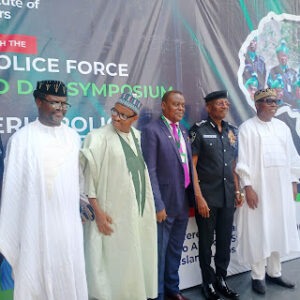
In a world increasingly shaped by conflict, fragile states and complex security threats, Nigeria’s contribution to global peacekeeping has often unfolded far from the spotlight. Yet, on Victoria Island, Lagos, the story of that enduring legacy took centre stage as the Nigerian Institute of International Affairs (NIIA) and the Nigeria Police Force (NPF) convened a two-day international symposium to reflect, reassess and reimagine Nigeria’s role in peace operations across Africa and beyond.
The symposium, aptly titled “The Nigeria Police and the Peace Process in Africa,” was more than an academic gathering. It was a moment of institutional introspection—one that traced Nigeria’s quiet but consequential journey in international policing from the early days of independence to today’s complex global security landscape.
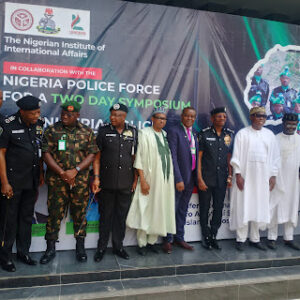
Opening the event, the Director-General of NIIA, Professor Eghosa Osaghae, set the tone by describing the Nigeria Police Force as “Africa’s showcase police force,” with a record of international peace operations stretching over six decades.
From the Congo in 1960, where Nigerian police officers joined one of the United Nations’ earliest peacekeeping missions in Africa, to contemporary deployments across Europe, Asia, the Caribbean and the Middle East, Osaghae noted that Nigeria’s policing footprint has extended far beyond its borders.
“Not many people know that in far-flung places such as East Timor, Kosovo, Haiti, Somalia, Sudan, the Czech Republic and many other global flashpoints, the Nigerian Police Force has been there, doing extraordinary things in pursuit of international peace, security and prosperity,” he said.
According to Osaghae, Nigeria’s contributions are remembered not only across Africa but also in regions as diverse as Europe, Asia and the Caribbean—placing the country alongside India as one of the most consistent contributors to global peacekeeping policing.
He revealed that many Nigerian officers who served in international missions later rose to senior command positions under the United Nations, African Union and ECOWAS frameworks, underscoring a tradition of professionalism, competence and leadership.
Building Institutions for the Future
Beyond celebrating past achievements, the symposium also looked ahead. Osaghae announced plans for the establishment of an International Centre for Peacekeeping and Policing, to be jointly developed by NIIA and the Nigeria Police Force. The initiative, he said, would be complemented by an annual special lecture series dedicated to policing and peacekeeping.
“What the NIIA does best is strengthen capacity for understanding global complexities and addressing insecurity, peace and prosperity. This partnership with a forward-looking police force will not stop here,” he assured.
At home, however, Osaghae reminded Nigerians that global credibility begins with domestic realities.
“To have a better police, you need a better society. The police is the mirror of our development at any point in time,” he said, calling for public support and collective responsibility in addressing policing challenges.
A Force Shaped by History
Chairman of the occasion, Prince Dr Adewale Adebayo, took participants on a historical journey, tracing the evolution of the Nigeria Police from its origins in Lagos in 1861 to its formal emergence as a national force in 1930.
He described the police as an institution that has always been international in outlook, shaped by Nigeria’s political, economic and democratic evolution.
“Any commentary on a society starts with its police. The Nigerian Police Force reflects the realities of our development—its strengths and its challenges,” Adebayo observed.
For him, effective policing is inseparable from sustained investment.
“Good policing costs money. Forensics, investigations, technology and training are expensive. You cannot expect world-class policing without serious investment,” he said, stressing that no police force anywhere in the world is without imperfections.
Peacekeeping as a Global Responsibility
Delivering the keynote address, the Inspector-General of Police, IGP Olukayode Adeolu Egbetokun, framed peacekeeping as a moral and strategic obligation rather than a symbolic gesture.
“Peacekeeping is not merely the absence of armed conflict. It is the deliberate construction of conditions that allow human dignity, democratic governance, development and justice to flourish,” he said.
Egbetokun recalled that Nigeria’s engagement in international peace operations began immediately after independence, with police officers deployed to the UN mission in the Congo in 1960—marking one of Africa’s earliest police contributions to UN peacekeeping.
Since then, he noted, Nigeria has maintained uninterrupted participation in peace missions under the UN, African Union and ECOWAS across Africa, Europe, Asia, the Middle East and the Caribbean.
From Liberia and Sierra Leone to Kosovo, Haiti, Cambodia and Afghanistan, Nigerian police officers have served in some of the world’s most volatile environments.
A defining moment, the IGP said, was the deployment of Nigeria’s first Formed Police Unit in 2004, which marked a shift from observer roles to robust, mandate-driven policing.
Five Pillars of Contribution
According to Egbetokun, Nigeria’s value in modern peace operations rests on five core pillars:
Protection of civilians and community security
Rule of law and institutional capacity building
Electoral and democratic security
Specialised policing, including crowd control and protection of critical infrastructure
Leadership within the global policing architecture
He acknowledged emerging threats such as violent extremism, cybercrime and transnational organised crime, stressing that these challenges demand reform, innovation and stronger partnerships.
Credibility Begins at Home
As the symposium drew to a close, a recurring message echoed across sessions: Nigeria’s future relevance in global peacekeeping depends on the strength of its domestic institutions.
“International credibility is inseparable from domestic professionalism, accountability and respect for human rights,” Egbetokun concluded.
With diplomats, scholars, security experts and senior police officers in attendance, the gathering reinforced Nigeria’s strategic position—not just as a regional power, but as a quiet architect of peace across continents.