


By Fanayajo Ranti Margaret
The battle against cultism, drug abuse, cybercrime, violence and other social vices must begin long before criminal activities reach the streets, the Lagos State Security Trust Fund Campaign Against Crime, Cultism and Other Vices (LSSTF-CACCOV) has declared.
This was the thrust of a sensitisation and awareness programme organised by LSSTF-CACCOV in collaboration with the Federal College of Education (Technical), Akoka, Lagos, under the theme: “Vice-Free Campus: Taking a Firm Stand Against Cultism, Drug Abuse and Other Social Vices Among Youths.”
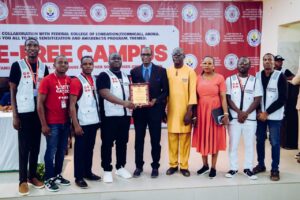
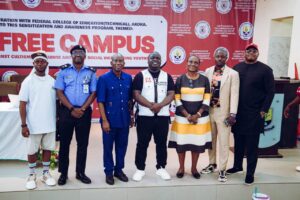
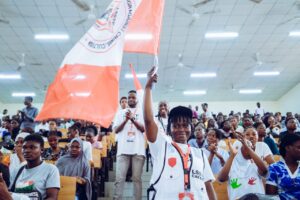
The programme brought together the institution’s management, students, security personnel, medical professionals, addiction specialists and other stakeholders in a direct conversation on the dangers of destructive choices and the need for young people to protect their future.
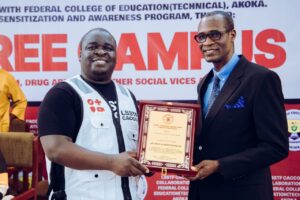
Beyond the sensitisation sessions, participants received counselling from the LSSTF-CACCOV team, while the Dr. Diya Medical Team provided free medical checks, courtesy of the Lagos State Security Trust Fund (LSSTF). The programme also featured the presentation of awards to the Acting Provost in recognition of the institution’s partnership and support for the initiative.
Delivering the keynote address, the State Coordinator of LSSTF-CACCOV, Dr. Moses Oladimeji, commended the Executive Secretary/CEO of LSSTF, Dr. Ayodele Ogunsan, for conceptualising and supporting the youth-focused initiative.
Oladimeji particularly praised Ogunsan for what he described as game-changing efforts in repositioning the security funding agency since assuming office in October 2025.
Using a real-life story to drive home his message, Oladimeji told the students about the tragic experience of Mayomi Fiwashewa, whom he described as a brilliant young Nigerian whose academic excellence had earned him outstanding results in WAEC and JAMB as well as scholarship opportunities.
According to him, Fiwashewa came from a poor background, with his mother making a living from operating a grinding mill. His academic brilliance, however, appeared to have opened the door to a promising future.
But the young scholar’s life reportedly took a tragic turn after he became involved with a girl associated with a cult group.
Oladimeji said what began as an apparently innocent relationship eventually exposed Fiwashewa to threats from the girl’s cultist boyfriend, leading him to seek protection by joining what was presented to him as an “elite” or “big boys” club.
That decision, he said, ultimately destroyed the young man’s promising future.
“He was brilliant, but he was not intelligent,” Oladimeji told the students, drawing a distinction between academic brilliance and the wisdom required to protect one’s destiny.
He said Fiwashewa was eventually initiated into the cult group and later expelled from the institution following a violent clash between rival groups.
According to Oladimeji, his expulsion devastated the family, with the news reportedly contributing to the death of his mother, who already suffered from high blood pressure.
Unable to disclose the true circumstances surrounding his expulsion, Fiwashewa reportedly drifted into criminal circles, eventually becoming involved in armed robbery.
Years later, he was arrested, prosecuted and sentenced to death by hanging.
Oladimeji said one of the most painful aspects of the story was that, on the eve of his execution, Fiwashewa reportedly dreamt that he had become a renowned neurosurgeon whose successful operations were saving lives and attracting national recognition.
“But when he was to wake up, he didn’t wake up in that dream to that reality. He woke up to a warder standing before him and saying, ‘Mayomi, your time has now come to an end,’” he narrated.
The LSSTF-CACCOV coordinator also drew attention to Fiwashewa’s friend, Ayo, who repeatedly warned him against joining the cult group.
For Oladimeji, the story underscores the power of friendship, peer influence and personal choices.
“We are here today telling you the same story. Don’t join bad gangs,” he told the students.
He urged them to reject cultism, drug abuse, prostitution and other destructive behaviours, while encouraging them to become ambassadors for a safer and vice-free society.
Academic Excellence Must Come With Character — Miller
The Acting Provost of FCE (Technical), Akoka, Dr. Isaac Oluwatoyin Miller, welcomed the initiative, stressing that academic excellence must go hand in hand with character, discipline and responsible citizenship.
He warned that cultism, drug abuse, cybercrime, sexual harassment, violence and other social vices threaten not only campus security but also the future of young Nigerians.
“As an institution entrusted with the education and development of young people, we recognise that academic excellence must go hand-in-hand with good character, discipline and responsible citizenship,” Miller said.
He urged the students to participate actively in the programme and take its lessons beyond the walls of the institution.
“Let each of you become an ambassador for a vice-free campus,” he declared.
Police: See Us as Partners, Not Just Enforcers
The Divisional Police Officer, Sabo Police Station, CSP Kehinde Ebinisi, reinforced the security message, urging students to regard the police as partners in protecting their lives, education and aspirations.
“Standing before you today, I want you to see beyond the uniform I’m wearing. I am here as a guardian of your peace, a protector of your dreams, and a partner in your academic journey,” Ebinisi said.
He highlighted the devastating consequences of criminal involvement, including injury, disability, trauma, death, academic disruption, isolation and family disgrace.
The DPO also encouraged students to report suspicious activities, particularly cult-related activities and other security threats within the school environment, assuring them that information could be handled confidentially.
“When you see something, you say something so that the police can do something,” he said.
Ebinisi further cited the widely reported case of former University of Lagos student Chidinma Ojukwu, convicted in connection with the killing of Super TV Chief Executive Officer, Usifo Ataga, as an illustration of how serious criminal involvement can derail education and alter the course of a young person’s life.
“Your future lies in your hands,” he repeatedly told the students.
Drug Abuse Often Starts With ‘Just One’ — Dr. Diya
The medical dimension of the campaign was presented by Dr. Diya Ololade, Executive Director and Deputy Director of Clinical Services, Atlantis Pediatric and Multi-Specialist Hospital.
Diya challenged the perception that drug abuse only becomes a problem when addiction becomes obvious.
Drawing from his clinical experience, he explained that substance abuse can begin innocently through a pill, drink, cigarette or other substance offered by a friend during examination periods, social gatherings or moments of emotional distress.
“Substance abuse doesn’t start in a dark alley. It starts with a pill, a drug, a drink, offered by a friend during exam week or at a harmless party or get-together,” he warned.
He identified academic pressure, financial challenges, relationship problems, loneliness, peer influence, the desire to belong and digital culture as factors that can increase young people’s vulnerability to substance abuse.
Diya particularly cautioned students against self-medication and the misuse of prescription drugs such as tramadol and codeine, stressing that a drug being prescribed or legally available does not automatically make it harmless.
He explained that substance abuse can affect major organs, including the brain, liver, kidneys, lungs and reproductive system, while also worsening anxiety, depression and other mental health challenges.
“The stress, the pressure, the loneliness. None of it makes you weak. It makes you human,” he told the students.
“The goal of medicine is not just to add years to life, but life to years,” he added.
‘I Can Stop Whenever I Want’ — Dangerous Addiction Mindset
Also speaking, Dr. Adetolu Isaac Olatunde, a Certified Addiction Professional, focused on the early warning signs of addiction and the need for young people to seek help before substance use becomes dependence.
He explained that drugs are chemical substances capable of altering the biological system of the body and warned students against assuming that they would always remain in control of their substance use.
He identified thoughts such as “I am strong enough to handle my drug use” and “I will quit whenever I want” as dangerous assumptions associated with substance abuse.
According to him, dependence can gradually transform what began as a personal choice into something the individual feels unable to do without.
He therefore urged students to recognise the warning signs early and seek professional support whenever necessary.
Odili: Prevention Is Everyone’s Responsibility
For the Chief Executive Officer of Phenomenal Strides Foundation, Mrs. Ibiba Odili, the fight against drug abuse must be approached as a personal responsibility.
Speaking on “Drug Abuse: Shielding Self, My Responsibility, My Journey,” Odili urged students to understand that prevention should not be left solely to parents, schools, government or law enforcement agencies.
She described drug abuse as “borrowing a fake solution today at the expense of your tomorrow,” using the imagery of an eggshell, snail shell and womb to illustrate the importance of creating protective structures around one’s life.
She encouraged young people to build those protective structures through strong values, discipline, positive relationships and purposeful decision-making.
Odili also warned that the drug problem is evolving, with new psychoactive substances and emerging patterns of misuse creating additional challenges for young people.
Building a Safer Generation
The convergence of security enforcement, education, medical intervention, addiction counselling and community engagement at the FCE (Technical), Akoka programme reflected a growing recognition that the battle against social vices cannot be won through arrests and prosecution alone.
Prevention, stakeholders stressed, must begin with education, early intervention, positive peer influence and empowering young people to make responsible choices.
The message from the “Vice-Free Campus” campaign was clear: cultism may present itself as protection, drugs as an escape, peer pressure as friendship and criminality as a shortcut to success, but the consequences can destroy years of education, family sacrifices and dreams.
For the students of FCE (Technical), Akoka, the challenge is therefore not simply to avoid crime, but to choose courage over conformity, purpose over peer pressure and a meaningful future over temporary acceptance.