

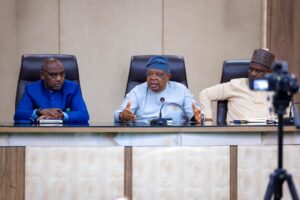
The Minister of Power, Mr Joseph Olasunkanmi Tegbe, has described his first 100 days in office as a period of “diagnosis and stabilisation,” highlighting infrastructure recovery, improved generation and transmission capacity, metering expansion and efforts to address the power sector’s debt burden.
Speaking at a media parley in Abuja to mark the milestone, Tegbe said the Federal Government had focused on repairing existing infrastructure, recovering stranded assets, restoring market discipline and strengthening governance across the electricity value chain.
He acknowledged that despite the progress recorded in some parts of the country, many Nigerians continued to experience unreliable electricity supply and the high cost of alternative power generation.
“When I say that there are improvements in certain places, I do not categorically deny the experiences of those that are yet to benefit,” the Minister said, stressing that the priority was to extend the gains to communities across the country.
According to Tegbe, the Ministry’s reform strategy is built around three key pillars: stabilising the electricity value chain, restoring market discipline and strengthening governance.
Among the major achievements highlighted was the restoration of the 375MW Alaoji open-cycle power plant to the national grid after three years of being offline.
The Minister also disclosed that newly commissioned transformers at Apapa, Ijora, Alausa and Lekki in Lagos had unlocked 672MW of transmission capacity, while a new 300MVA transformer at Katampe, Abuja, unlocked an additional 240MW.
He said operational records showed that generation and transmission had exceeded 5,000MW in recent weeks, compared with the 3,700MW–4,700MW range recorded before June. A generation peak of 5,330MW was also recorded during August and September.
Tegbe, however, cautioned that national generation figures alone could not fully reflect the electricity experience of individual communities.
On electricity access, the Minister said 62 solar and mini-grid projects across 30 states had delivered approximately 43.6MW of installed solar capacity and 41,735 new connections, with an estimated reach of more than 208,000 people.
He also announced the launch of the Renewable Asset Management Company (RAMCO) to professionally manage publicly financed renewable-energy assets and ensure their long-term sustainability.
On efforts to restore discipline in the electricity market, Tegbe said approximately ₦1.23 trillion had been raised towards addressing the sector’s debt backlog, as part of a broader programme targeting the estimated ₦3.3 trillion power-sector debt.
He added that about 350,000 electricity meters were installed during the first 100 days, bringing cumulative installations to 1,004,260 as of August 2026.
The Minister also stated categorically that the Federal Government has no plan to increase electricity tariffs, while assuring Nigerians that governance reforms would focus on greater transparency, clearer performance indicators and scorecards, publication of costs and operator performance, universal metering and stronger accountability across the electricity value chain.
Looking ahead, Tegbe identified four major priorities for the Ministry: deeper grid stabilisation along the Lagos, Enugu-Port Harcourt and Abuja-Kaduna-Kano corridors; development of the Transmission Super Grid; improved utilisation of existing power assets by connecting supply to productive economic clusters; and preparation of infrastructure to meet future electricity demand.
He said that over the next six months, the Ministry would focus on translating the repairs and reforms already undertaken into more visible improvements in electricity reliability, billing accuracy and the resolution of faults and consumer complaints.
“Our original commitment to visible, incremental improvements remains the benchmark,” Tegbe said.
He urged Nigerians to support the ongoing reform programme and called on communities to protect electricity infrastructure against vandalism and theft.
Tegbe reiterated that the ultimate objective of the reforms was to build a reliable and sustainable electricity sector capable of supporting businesses, strengthening economic growth and improving the daily lives of Nigerians.