

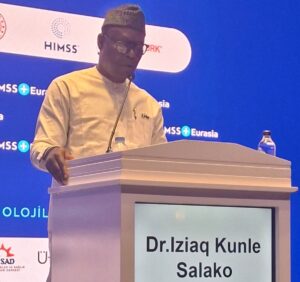
Nigeria has reaffirmed its determination to fast-track the digital transformation of its healthcare system as the Minister of State for Health and Social Welfare, Dr. Iziaq Adekunle Salako, delivered an inspiring opening address at the HIMSS Eurasia HealthTech Conference and Exhibition on November 26, 2025, at the Susesi Luxury Resort, Belek–Antalya, Turkey.
Representing President Bola Ahmed Tinubu’s administration, Dr. Salako conveyed Nigeria’s appreciation to the Turkish Ministry of Health and the HIMSS Eurasia organizing committee for hosting global experts, innovators, and policymakers shaping the future of digital health.
He emphasized the pivotal role technology now plays in revolutionizing global health systems, citing advancements in artificial intelligence, robotics, genomics, digital hospitals, computer vision, and smart facilities as game changers already reshaping care delivery worldwide.
According to him, these innovations align strongly with Nigeria’s health sector priorities under the Health Sector Renewal Investment Initiative.
Dr. Salako highlighted that rising population demands, shifting disease patterns, and the growing need for high-quality, patient-focused care have made digital transformation not just desirable but essential for modern health systems. He noted that the Tinubu administration is implementing a comprehensive strategy built on four pillars — improved governance, quality service delivery, a robust healthcare value chain, and strong health security.
A major anchor of this strategy is the integration of digital health solutions across all levels of care, particularly in primary healthcare, disease surveillance, and data interoperability between public and private institutions.
He outlined Nigeria’s ongoing investments in digital health infrastructure, including the National Digital Health Architecture (NDHA) under the Nigeria Digital in Health Initiative (NDHI), which aims to eliminate fragmentation in the health information landscape.
Other key initiatives include the establishment of a national Health Information Exchange with shared health records, national health registries, workforce information systems, strengthened data governance frameworks, and deeper collaboration with private innovators, startups, and global technical partners.
“These digital highways will provide a single source of truth and create sustainable rules for a more efficient ecosystem,” he stated.
Describing HIMSS Eurasia as “more than an event,” Dr. Salako said it represented a platform for deepening bilateral ties, accelerating innovation exchange, and strengthening global collaboration. He welcomed the strong presence of African countries, describing it as proof of the continent’s readiness to leapfrog outdated systems using technology-driven solutions.
While acknowledging the immense promise of AI, robotics, and advanced data tools, the Minister stressed the need for equity, affordability, and respect for national data sovereignty — especially for low- and middle-income countries.
“Technology must serve people. Digital tools must close gaps, not widen them,” he cautioned.
Dr. Salako called on global health and technology stakeholders to unite in leveraging digital solutions to achieve the United Nations Sustainable Development Goal of ensuring healthy lives and well-being for all.
He concluded by expressing profound gratitude to the organizers while wishing delegates a productive and impactful conference.
#LOYAMP
Categories: News