
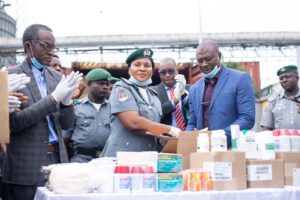

Customs Hands Over Seized Expired Drugs to NAFDAC, Reinforces Crackdown on Unsafe Pharmaceuticals
The Nigeria Customs Service (NCS) has officially handed over a consignment of seized expired pharmaceutical products to the National Agency for Food and Drug Administration and Control (NAFDAC) for regulatory action and safe disposal, underscoring the agencies’ unwavering commitment to protecting public health.
Receiving the intercepted products on behalf of NAFDAC, the Deputy Director, Port Inspection Directorate, Pharm. Adepoju Bayo Raufu, praised the Nigeria Customs Service for its vigilance, professionalism, and sustained collaboration in preventing expired and harmful pharmaceutical products from reaching Nigerian consumers.
He assured that NAFDAC would immediately commence the necessary regulatory processes to ensure the safe destruction of the expired medicines in strict compliance with existing laws, regulatory guidelines, and safety protocols.
Also speaking, the Zonal Director of NAFDAC, South-South Zone, Pharm. Chukwuma Oligbu, described the handover as a clear demonstration of the strong partnership between NAFDAC and the Nigeria Customs Service. He commended the Customs Area Controller, Comptroller Salamatu Atuluku, and officers of the Port Harcourt Area I Command for their professionalism, diligence, and steadfast commitment to safeguarding public health.
Pharm. Oligbu further called for sustained collaboration among security, regulatory, and enforcement agencies to strengthen efforts against the importation and circulation of expired, substandard, falsified, and unsafe pharmaceutical products across the country.
The ceremony concluded with the formal transfer of the intercepted expired pharmaceutical products, alongside the relevant documentation, from the Nigeria Customs Service to NAFDAC for appropriate regulatory action and environmentally safe disposal.
The exercise reaffirmed the shared resolve of both agencies to strengthen border security, protect public health, and ensure that only safe, genuine, and duly regulated pharmaceutical products are allowed into Nigeria through its ports.
Skip to content


VGN Anti-Robbery Commander. AC. Temitope Odubela: Professionalism, Training Drive Our Success in Community Security
Dangote Foundation Targets 2 Million Vulnerable Women Through Refinery IPO …Partners State Governments to Promote Women’s Financial Inclusion
Jamara Home Launches ‘Back to Smart Living’ Campaign, Offers Special Deals on Home Appliances
Bigi Soundcity OnTour Rocks YABATECH as Opeyemi Emerges Bigi Music Champion Music, dance and youthful creativity take centre stage as three-day campus activation ends on a high note
ITC, Access Bank Partner to Unlock Finance, Markets for SMEs Across 14 African Countries
Tegbe: 100 Days of Power Reforms Lay Foundation for More Reliable Electricity
Adron Homes Unveils Premium Estate in Ile-Ife, Deepens Commitment to Olojo Festival
Dangote: Refinery IPO Deepens Africa’s Ownership of Strategic Assets, Supports Expansion
Oxygen X Takes Credit to Lagos Markets, Brings It Closer to Everyday Traders
Arridex Brings Large-Format Composite Manufacturing Capability Online at Omnifactory