


The Lagos State Security Trust Fund (LSSTF) has concluded the fifth edition of its two-day Statewide Inter-Agency Training Programme for Security Operatives, with security experts calling for the initiative to be adopted nationwide as a model for strengthening Nigeria’s security architecture.
The training, held from July 15 to 16, 2026, brought together personnel from various security and emergency response agencies across Lagos State for intensive capacity building, professional development, and enhanced inter-agency collaboration.
Speaking at the opening ceremony, the Executive Secretary/Chief Executive Officer of the LSSTF, Dr. Ayodele Ogunsan, reaffirmed his administration’s commitment to prioritising human capital development as a key pillar of security management in Lagos State.
According to him, while the LSSTF has continued to provide logistics and operational equipment for security agencies, equal attention must be given to the officers who use them.
“When I assumed office, I reviewed my statutory responsibilities. I saw clearly that we were providing logistics and equipment, but I asked myself, ‘Where are the people?’ That conviction gave birth to this monthly training programme because investing in people must never be secondary,” Ogunsan said.
He assured that the initiative would remain a permanent feature throughout his tenure, revealing that monthly training sessions for security operatives would continue across the state.
“I have five years to administer this organisation, and for every month of that period there will be training for security operatives in Lagos. Investing in people must become a permanent feature of our security architecture,” he stated.
Ogunsan also encouraged participants to take full advantage of the programme by building professional relationships, learning from experienced officers, and embracing discipline and mentorship beyond the classroom.
The lead facilitator, Professor Oka Martin Obono, described the programme as a strategic investment in the human capital required for modern security operations, stressing that emotional intelligence has become as important as tactical competence in today’s security environment.
He noted that security personnel operate under immense pressure and must develop greater self-awareness and emotional resilience to interact professionally with members of the public.
“Not everyone on the street is a criminal. Security personnel must be equipped to protect and serve the public with professionalism while maintaining operational effectiveness. When citizens see men and women in uniform, they should feel confidence, not fear,” he said.
Professor Obono also highlighted financial literacy as an important aspect of personnel welfare, noting that prudent financial management would help officers achieve long-term financial stability, especially after retirement.
Commending the Lagos State Government and the LSSTF for institutionalising the programme, the professor described it as a national model worthy of replication.
“This training by the Lagos State Government under the auspices of the LSSTF deserves commendation and should be emulated by other state governments. Continuous learning remains the most sustainable response to evolving security challenges, especially in a megacity like Lagos,” he said.
He further urged governments across the country to institutionalise, expand and sustain similar capacity-building initiatives, adding that regular assessment of officers’ operational needs would help guide future investments in security.
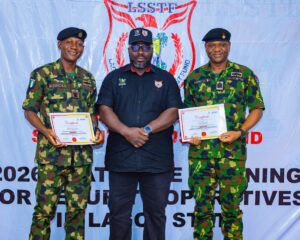
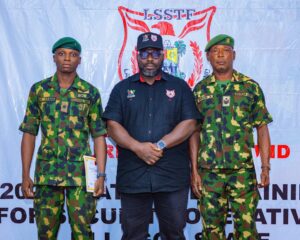
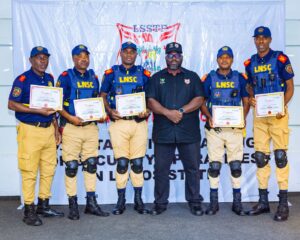
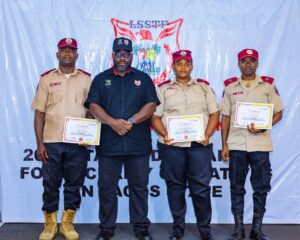
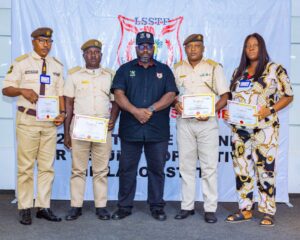
The training concluded with the presentation of certificates to participants drawn from the Nigeria Police Force, Department of State Services (DSS), Nigerian Army, Nigerian Navy, Nigerian Air Force, Nigerian Immigration Service, Federal Road Safety Corps (FRSC), National Drug Law Enforcement Agency (NDLEA), Nigeria Security and Civil Defence Corps (NSCDC), Nigerian Correctional Service, Lagos State Traffic Management Authority (LASTMA), Lagos State Neighbourhood Safety Corps (LNSC), Rapid Response Squad (RRS), Lagos State Taskforce, Force CID Annex Alagbon, Marine Police, Lagos State Environmental Sanitation Corps (LAGESC), Vigilante Group of Nigeria, Man O’ War Nigeria, Police Community Relations Committee (PCRC), and several other security and emergency management agencies.
The successful conclusion of the fifth edition further reinforces the LSSTF’s commitment to building a professional, intelligence-driven, and collaborative security ecosystem capable of addressing the evolving security challenges in Lagos State while promoting public confidence in law enforcement institutions.