


By Fanayajo Margaret
As Nigeria approaches another election cycle, the Lagos State Police Command has intensified its peace-building efforts, urging youths to reject political violence, digital thuggery, cultism and drug abuse and refuse to become tools for politicians seeking to manipulate the electoral process.
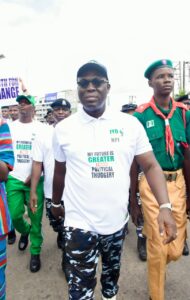
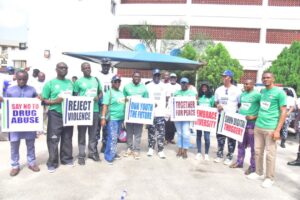
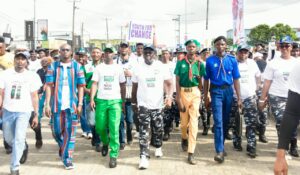
The message was the centrepiece of the Command’s Peace Walk held to commemorate International Youth Day (IYD) 2026, themed “Different Contexts, Common Aspirations,” during which the Campaign Against Political and Digital Thuggery was formally launched.
The initiative is also in line with the vision of the Inspector-General of Police, IGP Olatunji Rilwan Disu, to strengthen police-community partnerships and position young Nigerians as active stakeholders in peace, security and national development.
Leading the walk, the Commissioner of Police, Lagos State Command, CP Tijani Fatai, said the exercise was designed to sensitise youths and the wider public to the dangers of violence and other social vices.
“It is not in vain. Out there, people would have known by now what youth stands for. We are sensitising the youth, and not just the youth alone, the general populace, on the need to escape violence, thuggery, drug abuse, cultism and all of the vices you can think about,” Tijani said.
The Commissioner expressed particular concern about the approaching election period, warning youths against allowing themselves to be recruited for political violence.
“Most especially this time around that we are getting into the election period, we all know that the people that are to be used, or that have been used in the past, are the youth. None of these politicians will use any of their children for electioneering, thuggery or violence. It is these different children of nobody,” he stated.
However, Tijani rejected the notion that any young Nigerian should regard himself as a “nobody”, urging youths to look beyond immediate political gains and protect their future.
“There is nobody that is nobody. All of us are very important at this point. For the fact that we have not attained that high position does not make us nobody. Tomorrow is there for us. We should not think of today; we should always think of tomorrow,” he said.
He further charged youths to reject any invitation to electoral violence, stressing that participation in thuggery, drug abuse and other criminal activities could permanently damage their future.
“If anybody comes to us and uses us for any electoral violence, we should not allow it. We should dissociate ourselves so that our future can be better,” Tijani added.
The campaign received strong support from stakeholders in the transport sector. Comrade Isiaka Apena, Branch Chairman, National Union of Road Transport Workers, Ikeja Branch ‘B’, commended the police for complementing enforcement with public enlightenment.
“I’ve seen police at another level. It’s not only by arrest, but by educating our people. That election is coming. Don’t let them use you as a ballot box snatcher,” Apena said.
He pledged to take the message to transport workers and encourage members to promote peace in their respective communities.
Similarly, Germanus Anika, Public Relations Officer of PAVDA, representing phone sellers in Computer Village, assured the police that its members remained committed to law and order and opposed to political thuggery, drug abuse and cultism.
A representative of the NYSC youth corps members also appealed to young Nigerians to protect their future by shunning drug abuse, cybercrime and violence.
Reinforcing the message, SP Olivia Ugochukwu, State Coordinator of POCACOV, issued a direct warning to youths: “Shun thuggery. Drugs kill. Say no to hard drugs and cultism.”
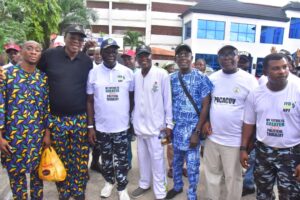
The Peace Walk brought together major youth, community and security stakeholders, including NYCN, NYSC, POCACOV, NANS, PCRC, NURTW, RTEAN, CRAN and NAOSNP.
The exercise commenced with physical activities led by the Command’s Officer in Charge of Sports, ASP Gregory Sylvester, before participants proceeded on the peace walk.
Beyond its symbolism, the initiative underscored a critical message ahead of Nigeria’s next electoral cycle: young Nigerians must refuse to become expendable tools in political contests whose consequences they—and not the politicians who recruit them—will ultimately bear.