

By Fanayajo Ranti Margaret
Nigeria’s quest to transform its electricity sector received fresh momentum as the Minister of Power, Joseph Tegbe, concluded a series of high-level engagements with major Chinese power engineering companies and financial institutions, securing stronger commitments toward the delivery of critical power infrastructure across the country.
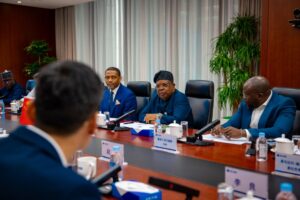
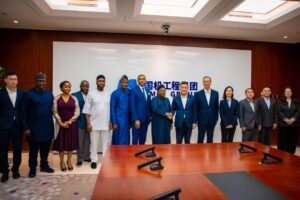
The engagements, held in Beijing as part of the ongoing Nigeria–China power sector mission, focused on one overriding objective: converting international partnerships into bankable projects, financed investments and completed infrastructure capable of delivering measurable improvements in electricity supply to Nigerians.
The discussions centred on accelerating projects under the Presidential Power Initiative (PPI) while expanding Chinese participation across Nigeria’s electricity value chain, spanning generation, transmission, project financing and industrial manufacturing.
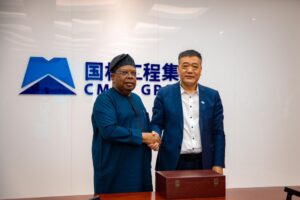
At a strategic meeting with Sinomach Group and China Machinery Engineering Corporation (CMEC), two major contractors involved in Nigeria’s generation and transmission programmes, Tegbe pushed for firm delivery timelines and accelerated completion of ongoing PPI projects.
The Minister also advocated a broader partnership model that would move beyond conventional engineering, procurement and construction contracts.
Under the proposed framework, Chinese partners would not only construct power infrastructure but also participate as co-investors, bringing capital, technology and technical expertise into generation, transmission, hydropower and related industrial projects.
Building on CMEC’s existing presence in Nigeria, Tegbe outlined the Federal Government’s expectation that the expanded partnership would lead to faster project completion, increased wheeling capacity and innovative blended-financing structures capable of unlocking additional investment in the power sector.
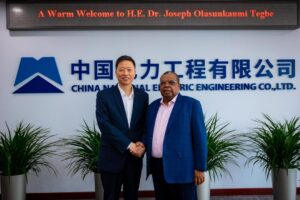
The Minister’s engagements also extended to the China National Electric Engineering Corporation (CNEEC), where discussions focused on strengthening cooperation in the expansion of Nigeria’s transmission network.
The emphasis on transmission is particularly significant, given that inadequate transmission capacity remains one of the major constraints affecting the ability of the electricity system to effectively deliver available generation to homes and businesses.
As part of the mission’s practical assessment of equipment and project readiness, the Nigerian delegation witnessed a factory acceptance test for high-voltage cables and other transmission materials at Hengfei Cable’s Changsha Industrial Park.
The testing process is designed to ensure that equipment destined for Nigerian transmission projects meets the required technical standards before shipment. Beyond quality assurance, the exercise is expected to help reduce installation delays and minimise the risk of technical challenges after the materials arrive in Nigeria.
Linking Power Supply to Industrial Growth
For Tegbe, however, Nigeria’s power transformation cannot be measured solely by the amount of electricity generated or the kilometres of transmission lines constructed.
Reliable electricity must ultimately translate into stronger economic activity, industrial production, job creation and improved productivity.
Against this backdrop, the Minister invited Chinese companies to explore investment opportunities in strategic sectors with significant electricity demand and strong potential to drive economic growth.
Among the sectors highlighted were steel, automotive manufacturing, digital infrastructure and data centres, cold-chain logistics and sugar processing.
Tegbe proposed the establishment of a structured Nigeria–China industrial cooperation platform capable of identifying, screening and developing bankable projects that align with Nigeria’s industrialisation priorities.
The proposed approach is designed to create a stronger connection between electricity infrastructure and industrial demand, ensuring that new generation and transmission capacity is supported by productive economic activity.
Such a model, the Minister indicated, could create jobs, attract fresh capital and strengthen the commercial sustainability of Nigeria’s power sector.
The Beijing engagements therefore represent more than another round of diplomatic and commercial discussions. They reflect an effort by the Ministry of Power to redefine international partnerships around measurable delivery, investment and long-term economic value.
With Nigeria seeking to expand electricity access while strengthening industrial capacity, the emerging Nigeria–China partnership could provide an important platform for mobilising capital, deploying technology and accelerating critical infrastructure.
For the Ministry, the message is straightforward: partnerships must become projects, projects must become energized infrastructure, and infrastructure must ultimately deliver reliable electricity and greater economic value to Nigerians.