

By Fanayajo Ranti Margaret
The Lagos State Commissioner of Police, CP Fatai Olayiwola Tijani, has called for a stronger partnership between the police and residents of Amuwo Odofin, stressing that the task of securing communities cannot be successfully handled by the police alone.
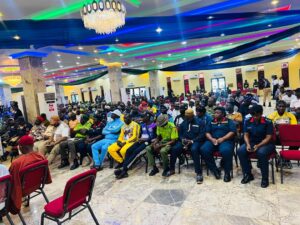
Tijani made the call at the Amuwo Odofin Town Stakeholders’ Meeting on Community Safety, where he charged traditional rulers, community leaders, market women, business owners, politicians, youths and other residents to unite with security agencies in the fight against crime and criminality.
The Commissioner said the security of Lagos must be treated as a collective responsibility, urging every resident to become more conscious of what happens within his or her immediate environment.
According to him, residents are strategically positioned to notice unusual movements, suspicious persons and activities before such situations escalate into serious security threats.
He therefore appealed to members of the community to promptly report anything unusual to the police and other relevant security agencies, stressing that timely information could make the difference between preventing a crime and responding to its aftermath.
Tijani also urged residents not to stop at merely reporting suspicious activities, but to remain committed to following up through appropriate channels so that necessary action could be taken.
He explained that effective community intelligence would enable the police and other security agencies to respond more quickly and efficiently to emerging threats.
‘Traditional Rulers Know Who Is Who’
The Commissioner placed particular emphasis on the role of traditional rulers and community leaders in maintaining peace.
He told the traditional rulers that their closeness to the people gives them valuable knowledge about the individuals and activities within their communities.
“You know who is who in your community,” Tijani stressed, urging traditional rulers to provide security agencies with useful information whenever they notice suspicious activities or individuals.
He, however, expressed concern that some community leaders might hesitate to report people suspected of criminal activities because they regard them as “their children.”
According to him, such an attitude could allow criminal elements to continue operating until their activities become too difficult for the community and security agencies to control.
The Commissioner therefore urged traditional rulers and other community leaders to put the collective safety of their communities above personal relationships whenever serious security concerns arise.
Youths and the Rising Security Challenge
Another major issue highlighted by Tijani was the increasing involvement of youths in criminal activities.
The Commissioner noted that young people constitute an important part of the community and must not be abandoned to influences capable of turning them towards crime.
He consequently called on parents, traditional rulers, religious leaders, community associations and other stakeholders to pay closer attention to the activities and welfare of youths.
For Tijani, preventing youth involvement in crime requires early intervention, proper guidance and a strong sense of community responsibility.
He urged stakeholders to work together to identify young people who may be vulnerable to criminal influences and help redirect them before they become deeply involved in criminality.
Community Vigilance as First Line of Defence
The Commissioner maintained that residents remain an important part of the security architecture because they live, work and conduct their daily activities within the communities.
He called on market women, business owners, landlords, politicians, youth groups and ordinary residents to maintain vigilance and establish functional communication channels with security agencies.
Tijani stressed that the police could not be physically present in every street, house, business premises and neighbourhood at all times.
Consequently, he urged residents to become the “eyes and ears” of the police by providing credible information whenever they observe developments capable of threatening peace.
He also warned against indifference, stressing that looking away when criminal activities are taking place could allow problems to grow until they become more difficult to control.
From Reaction to Prevention
The Commissioner’s message also reflected the need for a shift from reacting to crimes after they have occurred to preventing them before they happen.
He stressed that early information from residents could assist security agencies in identifying potential threats, carrying out necessary interventions and protecting communities from avoidable violence and criminality.
The Amuwo Odofin meeting therefore provided an opportunity for government representatives, traditional institutions, security agencies and community stakeholders to examine the security realities confronting the area and explore practical ways of strengthening collaboration.
A Safer Lagos Is Everyone’s Responsibility
As the meeting drew stakeholders from different sectors of the community, CP Tijani’s central message remained clear: security is not the responsibility of the police alone.
Traditional rulers must speak up. Parents must watch over their children. Market leaders and business owners must remain vigilant. Youths must reject criminality. Residents must report suspicious activities. And government and security agencies must continue to work closely with the communities they serve.
For Lagos, a rapidly growing megacity with expanding residential areas, businesses, markets, schools and transportation corridors, such collaboration is increasingly important.
Tijani therefore called on the people of Amuwo Odofin and Lagos State at large to embrace a culture of vigilance, cooperation and responsible information-sharing.
The goal, he stressed, is not merely to respond to crime after it occurs, but to prevent criminality, protect lives and property, and create communities where residents can live, work and conduct their businesses without fear.
Ultimately, the Amuwo Odofin stakeholders’ meeting reinforced a simple but powerful message: the police may lead the fight against crime, but the community must stand with them. Together, the people and security agencies can build a safer, stronger and more secure Lagos.