

By Fanayajo Ranti Margaret
For Nigerian businesses looking beyond the domestic market for their next phase of growth, Africa is increasingly becoming a marketplace of opportunity.
A fashion entrepreneur in Lagos can source premium fabrics from Ghana. A pharmaceutical distributor can procure essential products from Kenya. A manufacturer can settle invoices with suppliers in another African country, while a technology company can provide services to customers in Rwanda, Zambia or other emerging markets.
Yet, while identifying business opportunities across the continent may be easier than ever, moving money across borders has traditionally remained a major challenge.
The emergence of the Pan-African Payment and Settlement System (PAPSS) is changing that narrative, providing a payment infrastructure designed to make eligible cross-border transactions within Africa faster, simpler and more efficient.
For customers of Fidelity Bank Plc, PAPSS is becoming an important tool for navigating Africa’s expanding commercial landscape.
Making African Trade Easier
The growth of the African Continental Free Trade Area (AfCFTA) is creating new opportunities for businesses by promoting greater economic integration, market access and intra-African trade.
Farmers, traders, cooperatives, commodity aggregators, manufacturers, technology companies and small businesses are increasingly exploring opportunities beyond their home markets.
But every commercial transaction ultimately comes down to one critical question: How does the money move?
Traditional cross-border payment channels can require access to foreign currencies, multiple currency conversions and intermediary banks. Such processes may increase transaction costs, prolong settlement times and create uncertainty for businesses managing cash flow and supply chains.
PAPSS was developed to address many of these challenges.
Through the system, eligible transactions can be initiated in the sender’s local currency, with the beneficiary receiving the equivalent value in the applicable local currency. For Nigerian customers, this means eligible payments can be initiated in Naira, reducing the need to first source US dollars or euros for transactions within supported African corridors.
The result is a payment process that can help reduce unnecessary currency conversions and reliance on correspondent banking channels outside Africa.
Speed That Supports Business
In modern commerce, speed can determine whether a business secures a deal, receives supplies on time or maintains a valuable relationship with a supplier.
Fidelity Bank says eligible PAPSS transfers can be completed in as little as 120 seconds, subject to applicable requirements and the receiving market.
For businesses, faster settlement can translate into improved cash-flow management and greater certainty.
A manufacturer awaiting raw materials can settle an eligible invoice more efficiently. A retailer sourcing products from another African market can potentially avoid delays associated with obtaining foreign currency. An exporter can also receive eligible payments in Naira for goods sold within supported African markets, subject to applicable regulatory and export requirements.
More Than Business Payments
The benefits of PAPSS are not limited to corporate transactions.
The platform can support a range of eligible personal and commercial payments, including payments to suppliers, distributors and service providers. Parents and guardians can also make eligible education-related payments, while individuals may use the service for approved family support and other permitted transactions across supported African corridors.
This broad application makes PAPSS relevant not only to large corporations but also to entrepreneurs, SMEs, professionals and individuals with legitimate financial obligations across Africa.
Why Fidelity Bank Matters
For businesses seeking to take advantage of PAPSS, the choice of banking partner is crucial.
Fidelity Bank combines digital banking channels, branch accessibility and experience supporting SMEs, exporters and businesses seeking opportunities across Africa.
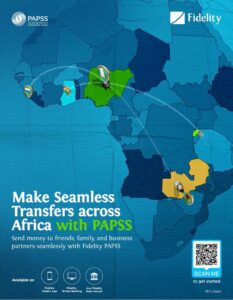
Eligible customers can initiate PAPSS transactions through the Fidelity Mobile App, Fidelity Online Banking or at a Fidelity Bank branch. Customers who require additional assistance can also engage their Relationship Managers or visit a branch for guidance on documentation and applicable transaction requirements.
The bank’s experience with PAPSS further strengthens its proposition.
Fidelity Bank onboarded PAPSS in September 2024 and recorded more than ₦46 billion in transactions during its early adoption phase, ahead of the platform’s official launch in August 2025.
PAPSS has also recognised Fidelity Bank among the first Nigerian banks to meet the relevant integration requirements, giving the financial institution significant experience in supporting customers using the platform.
Security and Compliance
Beyond speed and convenience, security remains a critical consideration in cross-border payments.
PAPSS transactions are processed through formal banking channels and are subject to applicable authentication, validation, compliance and regulatory checks.
Customers are therefore expected to provide accurate beneficiary information, clearly state the purpose of transactions and submit supporting documentation where required.
This structured approach gives businesses greater confidence while conducting eligible transactions across participating African markets.
Connecting Businesses to a Wider Africa
The expansion of PAPSS reflects a broader transformation in African commerce.
Businesses are increasingly using digital platforms to discover customers and suppliers, negotiate deals and coordinate operations across borders. Payment infrastructure must therefore evolve at the same pace.
According to TechCabal, PAPSS is live in 19 countries, connecting more than 160 commercial banks and over 15 national switches.
The expanding network is creating the foundation for a more connected African marketplace where businesses can trade across borders without the payment process becoming an unnecessary obstacle.
For Nigerian businesses, Fidelity Bank is positioning PAPSS as more than just another banking service. It is a gateway to a wider African commercial ecosystem.
Its early adoption of the platform, transaction experience, digital channels and nationwide branch network provide customers with multiple ways to access eligible cross-border payment services.
Positioning Nigerian Businesses for Growth
As intra-African trade continues to gather momentum, businesses that can move money efficiently will have an important advantage.
The ability to pay suppliers promptly, receive eligible proceeds efficiently and manage cross-border obligations with greater predictability can strengthen business relationships and support expansion into new markets.
With Fidelity Bank PAPSS, eligible customers can send money in Naira to selected African countries, while beneficiaries receive the applicable value in their local currencies.
For Nigerian entrepreneurs and businesses with their sights set beyond the domestic market, the message is increasingly clear: Africa is not simply a collection of separate markets. It is becoming a more connected commercial ecosystem.
And with payment solutions such as PAPSS, that ecosystem is becoming easier to navigate.
Africa is closer with PAPSS at Fidelity Bank.
Customers can visit the Fidelity Bank website or the nearest Fidelity Bank branch to initiate an eligible PAPSS transaction. Transactions are available across supported corridors and remain subject to applicable requirements, limits, charges, regulations, terms and conditions.