

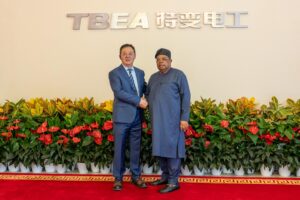
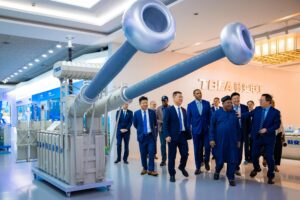
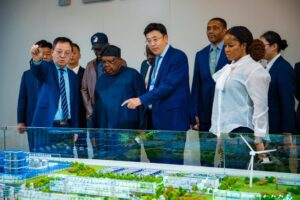
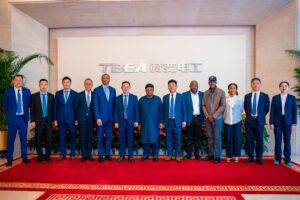
The Minister of Power, Joseph Tegbe, has secured a major commitment from leading Chinese power equipment manufacturer, TBEA, to establish a power and energy equipment industrial park in Nigeria.
The commitment was secured during a high-level meeting at TBEA’s headquarters in Beijing, held as part of the Minister’s working visit to engage original equipment manufacturers and technical partners involved in the Presidential Power Initiative (PPI).
The proposed industrial park is expected to position Nigeria as a regional manufacturing and export hub for critical power-sector equipment, reducing the country’s dependence on imports while creating jobs, promoting technology transfer and strengthening the capacity of indigenous suppliers.
Tegbe described TBEA as a strategic long-term development partner rather than merely a contractor, stressing that the Federal Government is seeking investors willing to bring technology, expertise and local capacity alongside capital.
At the meeting, TBEA also renewed its commitment to accelerate ongoing transmission and distribution projects across Nigeria. The projects include infrastructure expected to unlock more than 2,000MW of stranded electricity capacity for consumers and strengthen bulk power supply to the Federal Capital Territory.
The Minister called for faster delivery of projects under the Presidential Power Initiative and urged the extension of planned grid infrastructure to the East-West corridor.
He stressed that projects that have been contracted and substantially developed must be completed and delivered to Nigerians so that the intended benefits can begin to impact homes, businesses and industries.
The discussions also explored the feasibility of developing electric-vehicle charging infrastructure in Nigeria, potentially opening a new investment frontier as the country modernises its electricity grid and expands the integration of renewable energy and storage technologies.
The Beijing engagement underscores what the Federal Government described as a broader transformation of Nigeria’s power sector—from dependence on imported equipment to local manufacturing, from stranded electricity capacity to improved power delivery, and from short-term contractual relationships to long-term strategic partnerships.
For Nigeria, the objective remains clear: to build a reliable and industrially driven power sector capable of supporting manufacturing, creating jobs and sustaining long-term economic growth.